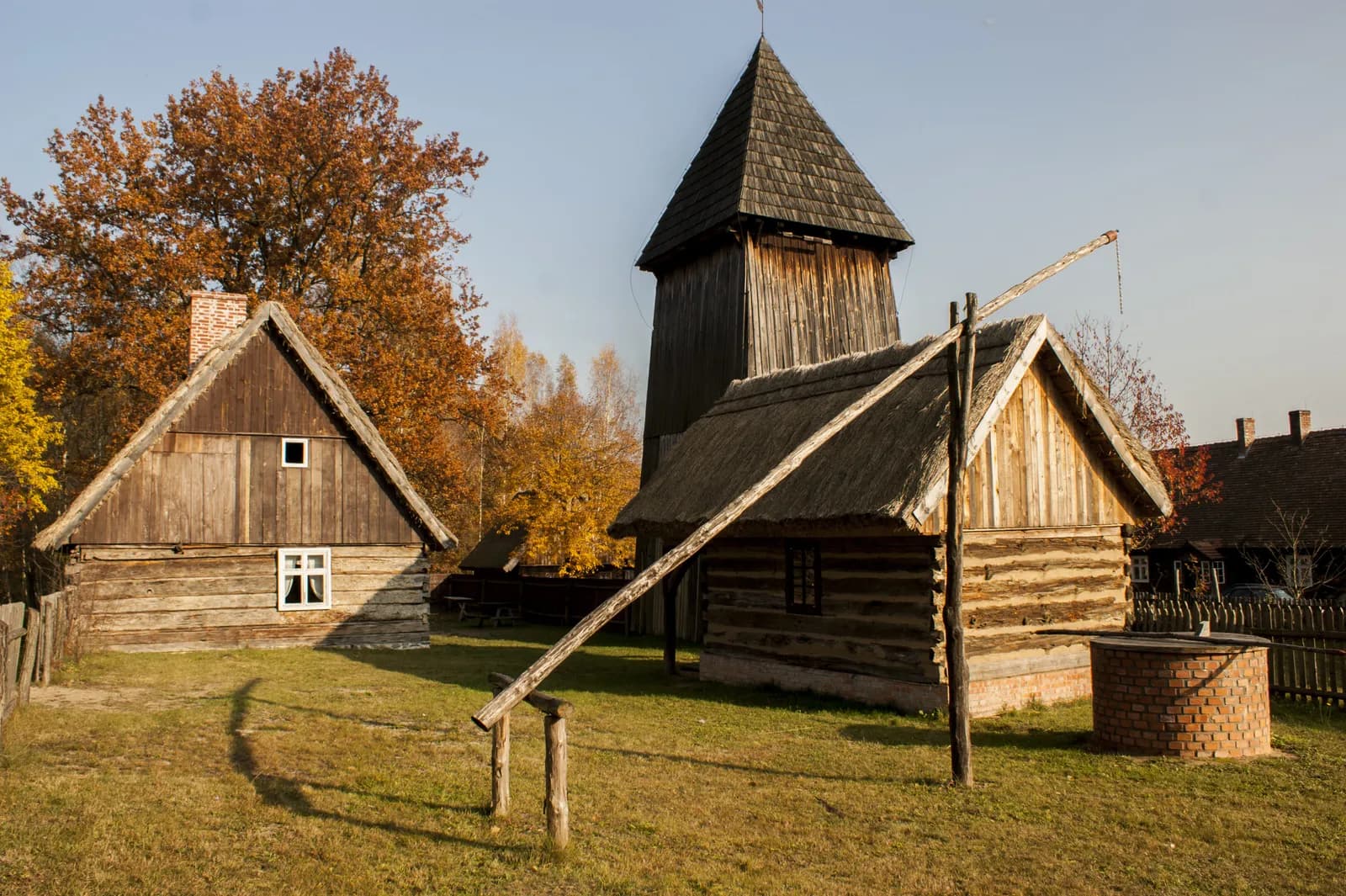
Across fields, woodland and ponds outside Zielona Góra, an entire village of historic buildings preserves the everyday world of generations past.
It is easy to think of an open-air museum as a collection of old buildings brought together for visitors to admire. In Ochla, however, the scale of the Ethnographic Museum creates something closer to a historical landscape.
Spread across more than 13 hectares on the outskirts of Zielona Góra, the museum brings together almost 80 historic structures and more than 10,000 artefacts. Cottages, farm buildings, workshops, religious structures and other elements of rural architecture are arranged within a landscape of woodland, meadows and ponds.
The result is a place where the history of Lubusz Land can be encountered through the spaces in which people once lived and worked.
The museum's collections and research extend beyond the central Lubusz region to Western Greater Poland, Lower Lusatia and Lower Silesia. Together, they document traditional architecture, crafts, clothing, tools, customs and the everyday lives of rural communities.
The story began long before the museum opened
Although the Ethnographic Museum was formally established as an independent institution in 1982, its origins reach back to 1960, when an ethnographic department was created within the Lubusz Land Museum in Zielona Góra.
The purpose was practical as well as scholarly. Researchers were collecting everyday objects, agricultural tools, craft products, folk costumes and textiles at a time when traditional rural life was undergoing significant change. Modernisation threatened to make many such objects obsolete, while the social and cultural transformations that followed the Second World War were reshaping the region itself.
A decisive step came in 1972, when plans were made to establish a folk architecture park in Ochla. The first building was moved to the site in 1973: a cottage from Potrzebowo dating from 1683.
By 1976, the open-air park had been combined organisationally with the ethnographic department, creating the Zielona Góra Ethnographic Park. Six years later, the institution became the independent Ethnographic Museum in Zielona Góra, based in Ochla.
The history matters because the museum is not simply preserving an earlier rural world. It is also preserving evidence of the changes that made that world vulnerable to disappearing.
Architecture makes everyday life visible
Walking through the museum means moving between different kinds of buildings rather than simply looking at objects inside display cases.
The historic structures include cottages, farm buildings, barns, cowsheds, workshops, a windmill, a watermill and small religious buildings. Many have been relocated to the museum site and furnished to create interiors illustrating aspects of traditional rural life.
Inside them, visitors encounter household equipment, tools, textiles, costumes and examples of folk art. These objects are modest in scale compared with the monumental architecture found in many museums, but that is part of their importance.
A household object can reveal how work was organised. A piece of clothing can point towards local traditions and materials. A workshop can show the skills required to produce things that were once made locally rather than bought as industrial products.
The museum also continues to study folk art and material culture. Its research records traditions from both long-established local communities and populations who settled in the region after the Second World War. The museum describes this mixture as part of the cultural mosaic of the Western Lands.
A changing region, preserved in more than one form
This is perhaps where Ochla becomes particularly interesting. Its collections do not represent a single, unchanging idea of regional identity.
Lubusz Land underwent major demographic and cultural changes after 1945, including the resettlement of people from the former eastern territories of Poland and other parts of the country. The traditions they brought with them became part of the developing cultural landscape of the region.
The museum therefore documents not only what rural life looked like before modernisation, but also how traditions adapted and combined as communities changed. Its work extends into intangible heritage through events, demonstrations, educational programmes and workshops.
That living element is important. Traditional culture can easily become something encountered only through photographs or display cases. At Ochla, demonstrations and workshops create opportunities for visitors to encounter skills and practices as activities rather than simply as historical information.
The museum's programme also changes with the seasons, with cultural events and traditional celebrations forming part of its role within the region.
The Baroque manor adds another chapter
The museum's story extends beyond the open-air village itself.
In Ochla stands a seventeenth-century Baroque manor house built between 1684 and 1687 as a noble residence. The building has passed through several owners and, during the twentieth century, experienced very different uses before becoming part of the Ethnographic Museum in 1982.
Following a comprehensive revitalisation carried out in 2023 and 2024, the manor now operates as the Centre for European Cultures. It provides space for exhibitions, cultural events, concerts, educational activities and academic meetings.
Its presence broadens the experience of Ochla. The museum is not limited to rural cottages and farm buildings, but encompasses different layers of the area's architectural and cultural history.
For visitors, this combination makes the museum more than a reconstruction of village life. It is a place where architecture, objects, landscape and human movement come together to explain how a region acquires its identity.
The buildings may have come from different places and periods, but together they form a record of a landscape that has continually changed. That is ultimately what makes Ochla valuable: it does not preserve the past as something entirely separate from the present. Instead, it shows how traditions survive, adapt and become part of the story of a place.
6. Visitor Information
Museum: Ethnographic Museum in Zielona Góra-Ochla
Address: ul. Ochla-Muzealna 5, 66-006 Zielona Góra
Museum grounds: More than 13 hectares, with approximately 80 historic structures and more than 10,000 artefacts.
Opening hours supplied for the main season:
1 May–30 September, 10:00–17:00.
The museum states that visitors should leave the grounds by 18:00.
Admission, 1 March–31 October:
Standard: PLN 20
Reduced: PLN 15